
Abstract
This article analyzes the evolution of scientific publishing in Brazil through the 40-year trajectory of the Brazilian Association of Scientific Editors (ABEC Brasil). Founded in 1985 during the country’s redemocratization, ABEC Brasil emerged to structure a previously fragmented and “craft-based” editorial landscape. Over 4 decades, the Association has spearheaded the transition from print to digital, the consolidation of Open Access (OA), and the implementation of Open Science paradigms. Amidst the current crisis in traditional peer review—characterized by reviewer fatigue and recruitment difficulties—this work discusses the rise of alternatives such as postpublication peer review as a means to ensure scientific agility. Furthermore, it highlights ABEC’s role in professionalizing the field through strategic international partnerships (Latin American Association of Scientific Editors [ALAEC], CSE, European Association of Science Editors [EASE], and Committee on Publication Ethics [COPE]) and its robust certification programs (Scientific Publication Training Program [ProCPC] and ABEC Certification Tracks). By aligning local editorial practices with global ethical and technical standards, ABEC Brasil reinforces the credibility, integrity, and international visibility of Brazilian journals, securing its position as a vital catalyst for the national scientific ecosystem.
Introduction
Founded on November 28, 1985, by a group of visionary scientists, ABEC Brasil emerged from the urgent need to structure the nation’s scholarly communication. To grasp its significance, one must contextualize the landscape of that era: Brazil was experiencing the ferment of redemocratization, a period that brought winds of renewal to the scientific field. However, the role of the scientific editor remained largely isolated. The activity was “artisanal” in nature, carried out by passionate researchers who balanced journal management with their teaching and research responsibilities—frequently without formal training or clear institutional support.
Within this fragmented context, editors faced these challenges in isolation, dealing with irregular publication schedules and persistent difficulties in funding and distribution. The creation of ABEC Brasil was, therefore, the natural response of a community that needed to establish a collective identity in order to progress. Throughout 4 decades, the Association has both witnessed and guided the transition from print to digital, consolidating OA and, more recently, integrating artificial intelligence into the editorial ecosystem. It has effectively transformed what was once an isolated practice into a strategic career path for Brazilian science.
Strategic Partnerships and Institutional Performance
ABEC’s maturity is reflected in its capacity to build bridges. Strategic dialogue with Brazilian funding agencies—such as the Coordination for the Improvement of Higher Education Personnel (CAPES),1 the National Council for Scientific and Technological Development (CNPq),2 and the State Research Foundations (FAPs)—has been essential for aligning journal support policies with the actual needs of editors. Furthermore, there are joint efforts with societies with similar goals to amplify the community’s voice before government bodies, while a closer relationship with academia elevates editorial quality directly at the sources of knowledge production. This proximity to universities and research institutions is crucial for training editorial boards and disseminating best practices in journal management. Through workshops, lectures, and consulting services, ABEC Brasil contributes directly to improving the quality and professionalization of scientific editorial management within the very environments where knowledge is produced. Strengthening Brazilian science requires a united front.
Constantly in sync with new global paradigms—such as ethics, research integrity, and Open Science—ABEC has evolved from debates on printing and distribution to the implementation of crucial services. These include the assignment of DOIs and ORCIDs, as well as the adoption of similarity-check software.
Internationalization
ABEC Brasil also devotes significant effort to expanding its national borders. This cooperation is manifested through two primary fronts aimed at the active pursuit of partnerships with editors’ associations from other countries, facilitating a valuable exchange of expertise. Understanding management models, technological innovations, and quality standards adopted in other nations enriches domestic debate and inspires the development of new solutions to local challenges.
Through partnerships with CSE and EASE, ABEC promotes a valuable exchange of innovations and quality standards. More recently, this vision culminated in the foundation of ALAEC, in conjunction with Asociación Uruguaya de Revistas Académicas (AURA) and Asociación de Editoriales Universitarias de Colombia (ASEUC), strengthening the regional voice in the global debate.
The partnership with EASE enabled ABEC Brasil, in 2022, to lead the formation of the EASE Brazilian Regional Chapter.3 This initiative aims to strengthen scientific collaboration with international partners and provide its members with high-quality, up-to-date content, thereby driving the improvement and visibility of Brazilian journals within the international context.
In 2025, a decisive milestone was reached with ABEC’s affiliation with COPE. Serving as an ambassador for COPE guidelines in Brazil, the Association works on the translation and dissemination of flowcharts and codes of conduct, providing technical and ethical support to help editors navigate challenges such as plagiarism and conflicts of interest, thereby enhancing the prestige of Brazilian journals on the global stage.
Partnership with the CSE
The partnership between ABEC Brasil and the CSE began in 2015 with ProCPC, a version of the CSE Publication Certificate Program. The CSE Publication Certificate Program provides the fundamentals of scholarly publishing while simultaneously challenging editors to creatively address emerging issues.
The ProCPC was established to facilitate the training of Brazilian editors, with most certification requirements being fulfilled in Brazil during ABEC Brasil events. The program is designed for all individuals involved in scientific publishing—not only editors—who are interested in supplementing their training to perform their editorial roles with confidence and in accordance with up-to-date practices.
To obtain certification within a maximum period of 5 years, participants must fulfill 5 requirements, as presented in Table 1.
Table 1. ProCPC certification requirements.
| Requirement | Activity | Location |
| In-person events |
1 CSE annual meeting 2 ABEC meetings |
U.S. and Brazil |
| Digital education | 3 CSE online webinars | Online |
| Short courses | 2 Short courses at CSE annual meeting or in Brazil | U.S. or Brazil |
| Applied research | Research project on an emerging topic | Evaluated by CSE |
| Dissemination | Poster presentation at an event | U.S. or Brazil |
Applications for the ProCPC are currently suspended. The program has over 50 registered participants and has already certified 12 editors who have made their projects available to the entire community (Table 2).
Table 2. Editors certified by ProCPC and their projects.
|
Editor |
Project Title |
Core Theme |
|---|---|---|
| Ana Morais | Do You Really Want to Start a New Journal? | Editorial planning |
| Bruna Erlandsson | How Standards Help in the Discoverability of a Scientific Journal | Indexing and visibility |
| Edna Frasson S Montero | Misconduct in Brazilian Scientific Journals in the Field of Health: Plagiarism and Authorship | Ethics and integrity |
| Erica Ferraz | Manuscript Submission and Evaluation: Journal Characterization and Editor’s Perception | Editorial Workflow Management |
| Gustavo Cunha de Araújo | The Internationalization Process of a Humanities Journal: A Case Study of the Brazilian Journal of Rural Education | Internationalization |
| Herbert Kimura | Cover Letters in Submissions for a Brazilian Scientific Journal | Manuscript submission |
| Ilda Fontes | The Internationalization of Scientific Periodicals in Brazil: A Case Study of the RAE‐Journal of Business Administration | Internationalization |
| Leonardo F Fontenelle | Authorship Concentration in Health Sciences Journals from Latin America and the Caribbean | Bibliometrics and authorship |
| Roberto Tadeu da Silva | Mapping of Causes and Time to Retraction from Scientific Journals Indexed in PubMed | Integrity and retractions |
| Sigmar de Mello Rode | Guidelines on Best Practices for Strengthening Ethics in Scientific Publication | Editorial ethics |
| Silvia Regina Galleti | Best Editorial Practices: A Mapping of the Agricultural Science Journals in the SciELO Brasil Collection | Best editorial practices |
| Simone Appenzeller | Trend of Paper Retraction in PubMed | Integrity and retractions |
In addition to the hybrid program, ABEC Brasil promoted the Portuguese version of CSE’s White Paper on Promoting Integrity in Scientific Journal Publications,4 which resulted in the publication of the CSE Guidelines for Promoting Integrity in Scientific Journal Publications. The updated and revised work5 was launched during the 2017 ABEC Meeting.
ABEC Brasil Scientific Editor Certification
In 2021, the Association launched its own program: the ABEC Brasil Scientific Editor Certification. Based on a robust analysis of emerging themes, the certification is structured into training tracks that organize knowledge into 3 major areas: Management, Evaluation, and Tools/Technologies (Figure). This structure allows professionals to take individual courses or pursue the full title by completing 360 hours of training.
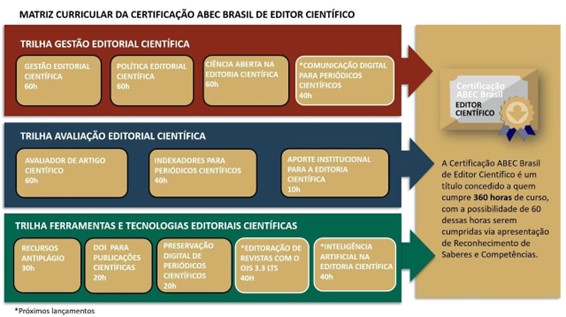
The objective of the training tracks is to categorize courses according to the specific activities that participants perform within scientific publishing. Although obtaining the certification requires completion of all tracks, for those seeking individual courses, this organization allows for the positioning of courses within areas such as the ones mentioned above.
The selection of themes and courses was based on the content presented at events organized by ABEC Brasil. Research conducted by Werlang6 identified 258 activities developed across 9 events held between 2014 and 2018. The most relevant themes from this study were proposed as the core curriculum for the courses.
Continuing Education and Reference Publications
ABEC’s commitment to transparency and quality is manifested in its extensive library of OA guidelines. Its guides cover fundamental themes, such as the General Data Protection Law within the Open Journal Systems framework, Open Science, and the Foz do Iguaçu Declaration on Sustainability (Table 3).
Table 3. Editorial guidelines and technical publications (Open Access)
| Focus Area | Main Titles |
| Ethics and integrity | |
| Open science | |
| Technologies | |
| Sustainability | |
| Desafios e perspectivas da editoria científica: Critical memories of the ABEC Meeting |
Abbreviations: ABEC, Brazilian Association of Scientific Editors; GDPR, General Data Protection Regulation; LGPD, Lei Geral de Proteção de Dados.
As it celebrates its 40th anniversary, ABEC Brasil reaffirms its role as a protagonist and guardian of editorial science. From in-person meetings to high-technology webinars, the Association demonstrates a successful migration from an approach focused solely on technical standardization to a strategic, professional, ethical, and inclusive vision. In doing so, it consolidates its position as the definitive reference for the future of scientific publishing in Brazil.
References and Links
- https://www.iie.org/programs/capes/
- https://www.gov.br/cnpq/pt-br
- [EASE] European Association of Science Editors. The EASE Chapter in Brazil: Fostering scientific collaboration. EASE; 2022. https://ease.org.uk/communities/brazil-chapter/
- [CSE] Council of Science Editors. CSE’s White Paper on Promoting Integrity in Scientific Journal Publications. CSE; 2018. https://www.councilscienceeditors.org/recommendations-for-promoting-integrity-in-scientific-journal-publications
- [ABEC Brasil] Brazilian Association of Scientific Editors. CSE guidelines for promoting integrity in scientific journal publications [in Brazilian Portuguese]. ABEC Brasil; 2017. https://dx.doi.org/10.21452/978-85-93910-00-5
- Werlang RB. The training of scientific editors in Brazil: a study of the activities of the Brazilian Association of Scientific Editors (2014–2018). [unpublished monograph]. 2019.
Sigmar de Mello Rode (https://orcid.org/0000-0002-4261-4217) is Full Professor, Dentistry School, São Paulo State University, UNESP; Silvia Regina Galleti (https://orcid.org/0000-0002-0745-5716) is a scientific researcher at the Biological Institute of the Secretariat of Agriculture and Supply of the State of São Paulo; and Edna Frasson de Souza Montero (https://orcid.org/0000-0003-1437-1219) is Associated Professor, Medicine School, São Paulo University, USP.
Opinions expressed are those of the authors and do not necessarily reflect the opinions or policies of their employers, the Council of Science Editors, or the Editorial Board of Science Editor.