
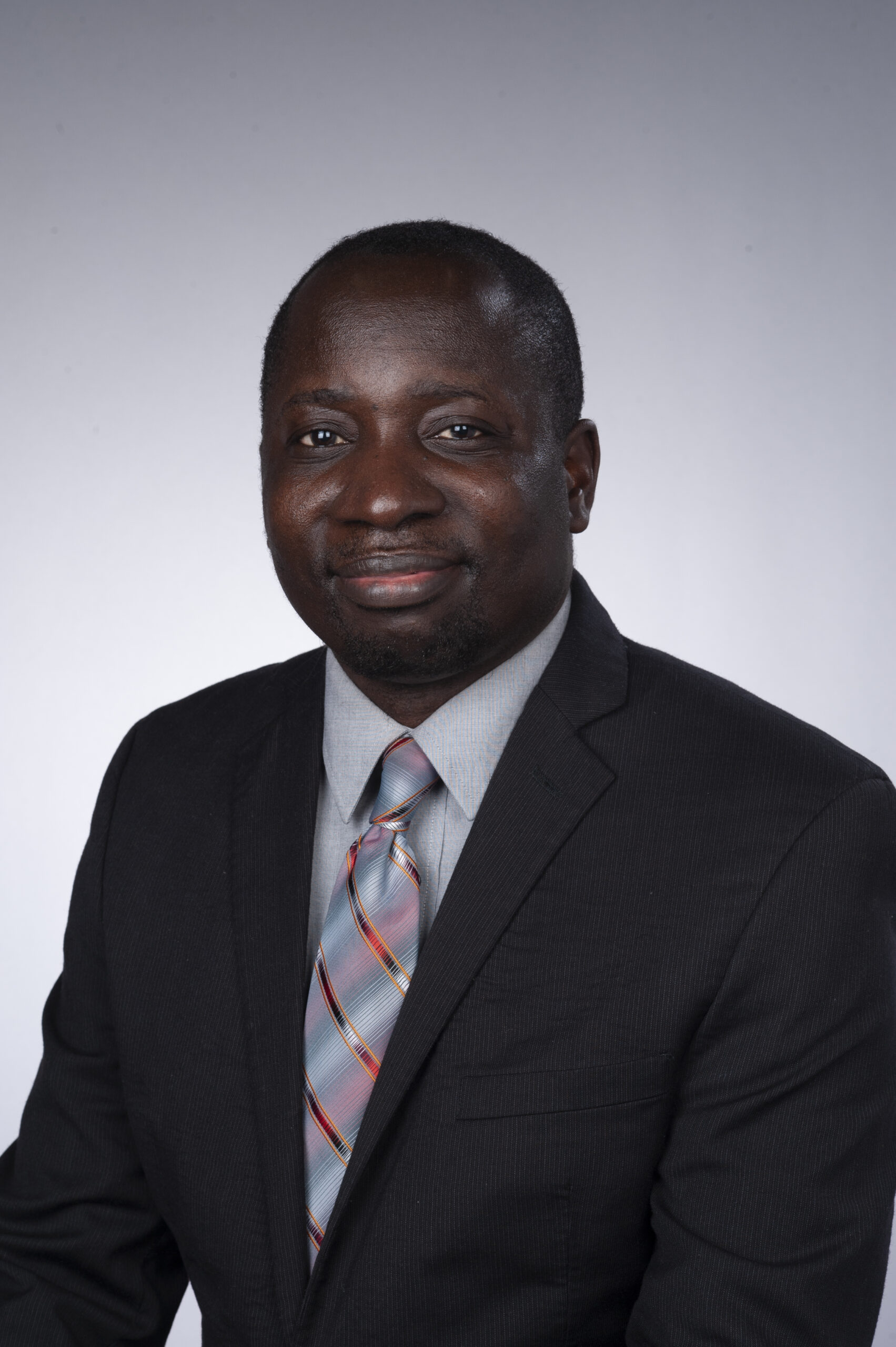
Bernard Appiah always knew he was meant for communication. In rural Ghana, where he was born, his father was a town crier, relaying vital information from the chief to the community. Like a shadow, Appiah followed his father admiringly as he made announcements.
When Appiah was entering 6th grade, his school tried to give him a similar leadership role, but there was a problem: He was far too small to intimidate the bigger students. Instead, he received the role of a school bell boy. “It’s break time, please!” Appiah remembers saying in a high-pitched voice as he rang the bell.
As he continued into high school, Appiah admired his English teachers, and he recalls one of his essays winning an award. With his knack for communication and fondness for biology, he earned the nickname “Aristotle” from his friends.
Over time, Appiah’s interests in communication, science, and service have led him to a career in international communication of public health. Along the way, he received a CSE international scholarship to attend the 2007 annual meeting and later was a Science Editor intern. And in November 2025, Appiah, now assistant professor in the Department of Public Health at Syracuse University, received from the American Public Health Association the K. Everett M. Rogers Award, which recognizes “outstanding contributions to advancing the study and/or practice of public health communication.” Appiah was honored for both.
The Path to His Profession
Appiah received a bachelor’s degree in pharmacy from Kwame Nkrumah University of Science and Technology in Ghana in 2002. While a student, he revived and edited The Student Pharmacist, the journal of the Ghana Pharmaceutical Students’ Association. He went on to work as a drug information pharmacist and publications manager for the National Drug Information Resource Centre, part of the Ghanaian Ministry of Health. He also published a guide for the public: Medicines: Using Them Safely.
Meanwhile, Appiah served as a coeditor of The Ghana Pharmaceutical Journal. While working on an assignment for this journal, he saw that applications for scholarships to attend the CSE meeting were being sought. The applications, however, were due that day. Given the time difference between Ghana and Texas, he managed to complete his application by the deadline. Thanks to the scholarship, he attended the 2007 CSE annual meeting in Austin, Texas.
At the CSE meeting, Appiah attended a session where the speakers included Barbara Gastel, who teaches at Texas A&M University and directs the Texas A&M master’s degree program in science and technology journalism. Appiah introduced himself after the session. Gastel was impressed, and their conversation led to his entering the program, during which he wrote a thesis on science journalism in Ghana.
While a Master’s student, Appiah interned for Science Editor, of which Gastel was editor-in-chief at the time. In this role, he wrote multiple pieces, including profiles, other feature articles, and meeting reports. One of his articles, “African Names: A Guide for Editors,”1 remains one of the most accessed articles on the Science Editor website. “It is a great example of the type of article that we like to publish in Science Editor, where an author takes an important topic and provides a clear and useful overview for editors and readers,” says Jonathan Schultz, current editor-in-chief of Science Editor.
During this time, Appiah also joined the leadership team of the international program AuthorAID, established to help researchers in low- and middle-income countries write about and publish their work. He remains involved with this endeavor, which has broadened its focus over the years and was recently renamed Rising Scholars.
A Doctorate and Academic Career
Appiah went on to earn a doctorate in public health at Texas A&M University; his dissertation was titled “Promoting Blood Donation in Sub-Saharan Africa: Role of Culture and Interventions.” During this time, he stayed active in the communication of science: In particular, he became a subeditor for the Science and Development Network (SciDev.Net)2 Sub-Saharan African English Gateway.
After receiving his doctorate in 2013, Appiah served on the faculty at Texas A&M University. In 2020, he moved to Syracuse University. He is an author of more than 35 refereed journal articles, and he has been a peer reviewer for nearly 20 journals. His teaching includes a course he created on global health communication and advocacy, and he proudly recounts how research that students developed in the course has been presented at conferences and won awards.
Appiah remained a regional subeditor for SciDev.Net until 2023. Said Jackie Opara, Sub-Saharan Africa regional deputy editor there: “When Bernard is doing editing for my story, I’m relaxed because I know it’s going to come back excellent and clean.”
The Award and Beyond
Appiah’s recent award from the American Public Health Association recognizes his multiple contributions to public health communication. “I felt very excited,” Appiah said, “because it highlights the work I do in underserved communities in low- and middle-income countries.”
Appiah identifies the 10+10+30 radio program format, which he developed, as a major factor in his receiving the award. In this format, each episode of a radio program contains 10 minutes of a serial drama with health-related content, then 10 minutes of community health workers discussing it, and finally 30 minutes for people to call in with questions. This approach has been successfully used to promote childhood vaccination in Ethiopia and to convey nutrition knowledge in Ghana.
Although honored to receive the award, Appiah says the impact of his work on his successors matters more to him than the awards he receives for it. “My goal is to help the next generation,” he says. “My hope is that some of those I teach will also go on to teach others.”
Appiah has come a long way from his days as a bell boy in Ghana. However, his interests, talents, and values have remained much the same as he has built a career in public health communication and related realms. As Opara puts it, “The award is for that boy who is still ringing the bell for his community.”
References and Links
- Appiah B. African names: a guide for editors. Sci Ed. 2010;33:15–17.
- http://scidev.net
Emily Velez (https://orcid.org/0009-0008-2029-7805) is a graduate student in science and technology journalism at Texas A&M University and the Shafer Editorial Intern at the Texas A&M University Press. Barbara Gastel (https://orcid.org/0000-0003-0804-2953) is a professor at Texas A&M University.